Minggu, 23 November 2014

[L597.Ebook] Free PDF Beyond IQ: A Triarchic Theory of Human Intelligence, by Robert J. Sternberg PhD

Free PDF Beyond IQ: A Triarchic Theory of Human Intelligence, by Robert J. Sternberg PhD

By downloading this soft file book Beyond IQ: A Triarchic Theory Of Human Intelligence, By Robert J. Sternberg PhD in the on-line web link download, you are in the primary step right to do. This website truly offers you simplicity of how you can get the very best e-book, from best seller to the brand-new released publication. You can find a lot more e-books in this site by visiting every web link that we supply. One of the collections, Beyond IQ: A Triarchic Theory Of Human Intelligence, By Robert J. Sternberg PhD is among the most effective collections to market. So, the first you get it, the initial you will get all favorable for this book Beyond IQ: A Triarchic Theory Of Human Intelligence, By Robert J. Sternberg PhD

Beyond IQ: A Triarchic Theory of Human Intelligence, by Robert J. Sternberg PhD

Beyond IQ: A Triarchic Theory of Human Intelligence, by Robert J. Sternberg PhD


Beyond IQ: A Triarchic Theory of Human Intelligence, by Robert J. Sternberg PhD

Free PDF Beyond IQ: A Triarchic Theory of Human Intelligence, by Robert J. Sternberg PhD

Beyond IQ: A Triarchic Theory Of Human Intelligence, By Robert J. Sternberg PhD How can you alter your mind to be much more open? There numerous sources that could help you to enhance your thoughts. It can be from the various other experiences as well as tale from some people. Book Beyond IQ: A Triarchic Theory Of Human Intelligence, By Robert J. Sternberg PhD is one of the trusted sources to get. You could discover plenty publications that we discuss below in this website. And currently, we show you one of the very best, the Beyond IQ: A Triarchic Theory Of Human Intelligence, By Robert J. Sternberg PhD

Here, we have various e-book Beyond IQ: A Triarchic Theory Of Human Intelligence, By Robert J. Sternberg PhD as well as collections to read. We additionally offer alternative types and also kinds of guides to search. The fun publication, fiction, past history, unique, scientific research, and other sorts of e-books are available here. As this Beyond IQ: A Triarchic Theory Of Human Intelligence, By Robert J. Sternberg PhD, it ends up being one of the preferred e-book Beyond IQ: A Triarchic Theory Of Human Intelligence, By Robert J. Sternberg PhD collections that we have. This is why you are in the best website to view the remarkable e-books to possess.

It won't take more time to obtain this Beyond IQ: A Triarchic Theory Of Human Intelligence, By Robert J. Sternberg PhD It won't take even more cash to print this publication Beyond IQ: A Triarchic Theory Of Human Intelligence, By Robert J. Sternberg PhD Nowadays, people have been so smart to make use of the technology. Why do not you utilize your device or various other tool to conserve this downloaded soft data book Beyond IQ: A Triarchic Theory Of Human Intelligence, By Robert J. Sternberg PhD This means will certainly allow you to constantly be accompanied by this book Beyond IQ: A Triarchic Theory Of Human Intelligence, By Robert J. Sternberg PhD Obviously, it will certainly be the very best friend if you read this book Beyond IQ: A Triarchic Theory Of Human Intelligence, By Robert J. Sternberg PhD up until completed.

Be the initial to obtain this publication now and also get all factors why you require to read this Beyond IQ: A Triarchic Theory Of Human Intelligence, By Robert J. Sternberg PhD The book Beyond IQ: A Triarchic Theory Of Human Intelligence, By Robert J. Sternberg PhD is not only for your tasks or requirement in your life. Publications will certainly always be a buddy in each time you check out. Now, allow the others understand about this page. You could take the advantages as well as discuss it likewise for your good friends and also individuals around you. By in this manner, you could truly obtain the definition of this e-book Beyond IQ: A Triarchic Theory Of Human Intelligence, By Robert J. Sternberg PhD beneficially. Exactly what do you consider our concept here?

Beyond IQ: A Triarchic Theory of Human Intelligence, by Robert J. Sternberg PhD

First published in 1985, this book presents a 'triarchic' theory of human intelligence that goes beyond IQ in its conceptualisation and implications for assessment. The theory has three parts. The first deals with relations between intelligence and experience; the second, with relations between intelligence and the external world; the third part with relations between intelligence and the internal world of the individual. Robert J. Sternberg begins by sketching the history of intelligence research. He then outlines the three parts of the theory and adduces supporting evidence, including evidence from studies of 'practical' as well as 'academic' intelligence. He considers the issues raised by exceptional intelligence and by intelligence testing. His conclusions will be of interest to all those concerned with intelligence, its development and its measurement.

  • Sales Rank: #1411995 in Books
  • Brand: Brand: Cambridge University Press
  • Published on: 1984-12-28
  • Original language: English
  • Number of items: 1
  • Dimensions: 9.02" h x .94" w x 5.98" l, 1.23 pounds
  • Binding: Paperback
  • 432 pages
Features
  • Used Book in Good Condition

Most helpful customer reviews

See all customer reviews...

Beyond IQ: A Triarchic Theory of Human Intelligence, by Robert J. Sternberg PhD PDF
Beyond IQ: A Triarchic Theory of Human Intelligence, by Robert J. Sternberg PhD EPub
Beyond IQ: A Triarchic Theory of Human Intelligence, by Robert J. Sternberg PhD Doc
Beyond IQ: A Triarchic Theory of Human Intelligence, by Robert J. Sternberg PhD iBooks
Beyond IQ: A Triarchic Theory of Human Intelligence, by Robert J. Sternberg PhD rtf
Beyond IQ: A Triarchic Theory of Human Intelligence, by Robert J. Sternberg PhD Mobipocket
Beyond IQ: A Triarchic Theory of Human Intelligence, by Robert J. Sternberg PhD Kindle

Beyond IQ: A Triarchic Theory of Human Intelligence, by Robert J. Sternberg PhD PDF

Beyond IQ: A Triarchic Theory of Human Intelligence, by Robert J. Sternberg PhD PDF

Beyond IQ: A Triarchic Theory of Human Intelligence, by Robert J. Sternberg PhD PDF

Selasa, 18 November 2014

[W927.Ebook] Free Ebook The Sound Machine: A Roald Dahl Short Story, by Roald Dahl

Free Ebook The Sound Machine: A Roald Dahl Short Story, by Roald Dahl

Be the very first to obtain this book now as well as obtain all reasons you require to read this The Sound Machine: A Roald Dahl Short Story, By Roald Dahl Guide The Sound Machine: A Roald Dahl Short Story, By Roald Dahl is not only for your responsibilities or requirement in your life. Publications will certainly always be a buddy in every single time you review. Now, let the others understand for this web page. You could take the perks as well as share it additionally for your pals as well as people around you. By in this manner, you could truly get the meaning of this publication The Sound Machine: A Roald Dahl Short Story, By Roald Dahl profitably. Just what do you consider our concept below?

The Sound Machine: A Roald Dahl Short Story, by Roald Dahl

The Sound Machine: A Roald Dahl Short Story, by Roald Dahl


The Sound Machine: A Roald Dahl Short Story, by Roald Dahl

Free Ebook The Sound Machine: A Roald Dahl Short Story, by Roald Dahl

The Sound Machine: A Roald Dahl Short Story, By Roald Dahl As a matter of fact, publication is actually a window to the world. Also many people could not appreciate reviewing publications; guides will always provide the specific info about reality, fiction, encounter, adventure, politic, religion, and also much more. We are here a website that gives collections of books more than guide shop. Why? We give you lots of numbers of connect to obtain the book The Sound Machine: A Roald Dahl Short Story, By Roald Dahl On is as you need this The Sound Machine: A Roald Dahl Short Story, By Roald Dahl You can find this book effortlessly right here.

Well, book The Sound Machine: A Roald Dahl Short Story, By Roald Dahl will make you closer to just what you are eager. This The Sound Machine: A Roald Dahl Short Story, By Roald Dahl will certainly be consistently great close friend any sort of time. You may not forcedly to consistently finish over reading a publication simply put time. It will certainly be simply when you have extra time and also spending couple of time to make you feel pleasure with exactly what you check out. So, you could obtain the definition of the notification from each sentence in the book.

Do you recognize why you should review this website and what the connection to checking out publication The Sound Machine: A Roald Dahl Short Story, By Roald Dahl In this modern-day period, there are several means to acquire the publication and also they will be a lot easier to do. Among them is by getting the e-book The Sound Machine: A Roald Dahl Short Story, By Roald Dahl by on-line as exactly what we tell in the web link download. The publication The Sound Machine: A Roald Dahl Short Story, By Roald Dahl could be an option due to the fact that it is so correct to your necessity now. To obtain the book online is quite simple by just downloading them. With this possibility, you can check out guide anywhere as well as whenever you are. When taking a train, awaiting list, as well as awaiting someone or various other, you could read this on-line book The Sound Machine: A Roald Dahl Short Story, By Roald Dahl as a good close friend again.

Yeah, reviewing an e-book The Sound Machine: A Roald Dahl Short Story, By Roald Dahl can add your good friends checklists. This is among the formulas for you to be successful. As understood, success does not mean that you have wonderful things. Comprehending as well as understanding more than various other will certainly give each success. Next to, the notification and impression of this The Sound Machine: A Roald Dahl Short Story, By Roald Dahl can be taken as well as selected to act.

The Sound Machine: A Roald Dahl Short Story, by Roald Dahl

The unabridged, digital audiobook edition of "The Sound Machine", a short, sharp, frightening story from Roald Dahl, the master of the shocking tale, read by the actor Adrian Scarborough.

In "The Sound Machine", Roald Dahl, one of the world's favourite authors, tells a sinister story about the darker side of human nature. Here, a curious invention reveals a horrifying truth about plants....

"The Sound Machine" is taken from the short story collection Someone Like You, which includes 17 other devious and shocking stories, featuring the wife who serves a dish that baffles the police; a sculpture comes between a scheming wife and her put-upon husband; the man waiting to be bitten by the venomous snake asleep on his stomach; and others. This story is also available as a Penguin ebook.

Roald Dahl, the brilliant and worldwide acclaimed author of Charlie and the Chocolate Factory, James and the Giant Peach, Matilda, and many more classics for children, also wrote scores of short stories for adults. These delightfully disturbing tales have often been filmed and were most recently the inspiration for the West End play, Roald Dahl's Twisted Tales by Jeremy Dyson. Roald Dahl's stories continue to make readers shiver today.

Adrian Scarborough's television work includes: Upstairs, Downstairs, Gavin and Stacey, Cranford, and Psychoville. His film work includes: The King's Speech, Gosford Park, The Madness of King George and Vera Drake.

  • Sales Rank: #218941 in Audible
  • Published on: 2012-09-13
  • Format: Unabridged
  • Original language: English
  • Running time: 37 minutes

Most helpful customer reviews

See all customer reviews...

The Sound Machine: A Roald Dahl Short Story, by Roald Dahl PDF
The Sound Machine: A Roald Dahl Short Story, by Roald Dahl EPub
The Sound Machine: A Roald Dahl Short Story, by Roald Dahl Doc
The Sound Machine: A Roald Dahl Short Story, by Roald Dahl iBooks
The Sound Machine: A Roald Dahl Short Story, by Roald Dahl rtf
The Sound Machine: A Roald Dahl Short Story, by Roald Dahl Mobipocket
The Sound Machine: A Roald Dahl Short Story, by Roald Dahl Kindle

The Sound Machine: A Roald Dahl Short Story, by Roald Dahl PDF

The Sound Machine: A Roald Dahl Short Story, by Roald Dahl PDF

The Sound Machine: A Roald Dahl Short Story, by Roald Dahl PDF

Rabu, 12 November 2014

[X274.Ebook] Download PDF The Idea of Justice, by Amartya Sen

Download PDF The Idea of Justice, by Amartya Sen

After downloading the soft documents of this The Idea Of Justice, By Amartya Sen, you can begin to review it. Yeah, this is so pleasurable while somebody ought to check out by taking their big books; you remain in your brand-new way by just manage your device. And even you are operating in the workplace; you can still make use of the computer to check out The Idea Of Justice, By Amartya Sen completely. Obviously, it will not obligate you to take numerous pages. Merely page by web page depending on the time that you need to read The Idea Of Justice, By Amartya Sen

The Idea of Justice, by Amartya Sen

The Idea of Justice, by Amartya Sen


The Idea of Justice, by Amartya Sen

Download PDF The Idea of Justice, by Amartya Sen

Why must get ready for some days to obtain or get the book The Idea Of Justice, By Amartya Sen that you get? Why must you take it if you can get The Idea Of Justice, By Amartya Sen the much faster one? You can locate the very same book that you purchase right here. This is it the book The Idea Of Justice, By Amartya Sen that you could obtain directly after buying. This The Idea Of Justice, By Amartya Sen is popular book worldwide, certainly lots of people will try to have it. Why don't you become the initial? Still puzzled with the way?

If you ally require such a referred The Idea Of Justice, By Amartya Sen publication that will provide you worth, get the best vendor from us now from lots of preferred authors. If you intend to entertaining books, numerous stories, story, jokes, and much more fictions compilations are also released, from best seller to the most recent released. You may not be perplexed to take pleasure in all book collections The Idea Of Justice, By Amartya Sen that we will give. It is not about the prices. It has to do with exactly what you need currently. This The Idea Of Justice, By Amartya Sen, as one of the best sellers below will certainly be one of the best choices to review.

Finding the best The Idea Of Justice, By Amartya Sen publication as the right requirement is kind of good lucks to have. To begin your day or to finish your day in the evening, this The Idea Of Justice, By Amartya Sen will certainly appertain sufficient. You could just look for the ceramic tile here and also you will certainly get the book The Idea Of Justice, By Amartya Sen referred. It will certainly not trouble you to cut your valuable time to opt for purchasing publication in store. In this way, you will additionally spend cash to spend for transport and also various other time spent.

By downloading and install the on-line The Idea Of Justice, By Amartya Sen book right here, you will obtain some benefits not to go for guide store. Just link to the net and begin to download and install the web page web link we discuss. Currently, your The Idea Of Justice, By Amartya Sen is ready to take pleasure in reading. This is your time as well as your peacefulness to obtain all that you want from this book The Idea Of Justice, By Amartya Sen

The Idea of Justice, by Amartya Sen

Social justice: an ideal, forever beyond our grasp; or one of many practical possibilities? More than a matter of intellectual discourse, the idea of justice plays a real role in how―and how well―people live. And in this book the distinguished scholar Amartya Sen offers a powerful critique of the theory of social justice that, in its grip on social and political thinking, has long left practical realities far behind.

The transcendental theory of justice, the subject of Sen’s analysis, flourished in the Enlightenment and has proponents among some of the most distinguished philosophers of our day; it is concerned with identifying perfectly just social arrangements, defining the nature of the perfectly just society. The approach Sen favors, on the other hand, focuses on the comparative judgments of what is “more” or “less” just, and on the comparative merits of the different societies that actually emerge from certain institutions and social interactions.

At the heart of Sen’s argument is a respect for reasoned differences in our understanding of what a “just society” really is. People of different persuasions―for example, utilitarians, economic egalitarians, labor right theorists, no�-nonsense libertarians―might each reasonably see a clear and straightforward resolution to questions of justice; and yet, these clear and straightforward resolutions would be completely different. In light of this, Sen argues for a comparative perspective on justice that can guide us in the choice between alternatives that we inevitably face.

  • Sales Rank: #88116 in Books
  • Published on: 2011-05-31
  • Released on: 2011-04-04
  • Original language: English
  • Number of items: 1
  • Dimensions: 9.22" h x 1.18" w x 6.18" l, 1.18 pounds
  • Binding: Paperback
  • 496 pages

Review
The most important contribution to the subject since John Rawls' A Theory of Justice. Sen argues that what we urgently need in our troubled world is not a theory of an ideally just state, but a theory that can yield judgments as to comparative justice, judgments that tell us when and why we are moving closer to or farther away from realizing justice in the present globalized world. (Hilary Putnam, Harvard University)

In lucid and vigorous prose, The Idea of Justice gives us a political philosophy that is dedicated to the reduction of injustice on Earth rather than to the creation of ideally just castles in the air. Amartya Sen brings political philosophy face to face with human aspiration and human deprivation in the real world, to whose improvement he has devoted his intellectual life. (G. A. Cohen, University of Oxford)

A major critical analysis and synthesis. Sen's inclusive approach transcends the many important scholars and viewpoints that he analyzes. The Idea of Justice presents a set of considerations on justice of importance to both the academic community and to the world of policy formation. (Kenneth Arrow, Nobel Laureate in Economics, Stanford University)

Few contemporary thinkers have had as much direct impact on world affairs as Amartya Sen/author. Wonderfully lucid. An invaluable compass for all those who fight injustice around the world. (Philippe Van Parijs, Louvain University)

In the courtliest of tones, Mr. Sen charges John Rawls, an American philosopher who died in 2002, with sending political thinkers up a tortuous blind alley. The Rawlsian project of trying to describe ideally just institutions is a distracting and ultimately fruitless way to think about social injustice, Mr. Sen complains. Such a spirited attack against possibly the most influential English-speaking political philosopher of the past 100 years will alone excite attention. The Idea of Justice serves also as a commanding summation of Mr. Sen's own work on economic reasoning and on the elements and measurement of human well-being...Mr. Sen writes with dry wit, a feel for history and a relaxed cosmopolitanism...The Idea of Justice is a feast...Nobody can reasonably complain any longer that they do not see how the parts of Mr. Sen's grand enterprise fit together...Mr. Sen ends, suitably, with democracy. It can take many institutional forms, he says. But none succeeds without open debate about values and principles. To that vital element in public reason, as he calls it, The Idea of Justice is a contribution of the highest rank. (The Economist 2009-08-06)

[Sen's] magnum opus on a line of work he's long addressed and now thoroughly re-examines: justice theory...In repeatedly bringing back into the discussion Adam Smith's Theory of Moral Sentiments, Sen signals the need for justice theory to reconnect to realistic human psychology, not the phony formal rationalism that infects modern economics or the for-sake-of-argument altruism that anchors Rawls's project. (Carlin Romano Chronicle of Higher Education 2009-09-14)

An original contribution to political philosophy. (Adam Kirsch City Journal 2009-09-11)

Sen's whole book is a cornucopia of commonsense humane advice combined with analytical insight, and far wiser than those thinkers who try to derive all their recommendations from one usually questionable overriding value. (Samuel Brittan Financial Times 2009-09-04)

In this intricate, endlessly thought-provoking book, Sen brings the full force of his formidable mind and his moral sense to show how specific questions--of chronic malnourishment, ill-health, demographic gender imbalance--must be analysed in terms of justice. Doing something about them is not a discretionary matter--it is a requirement of being human. Sen is the most sophisticated intellectual campaigner of our times--his arguments have shaped not just academic disciplines but the policies of governments and of global institutions like the World Bank. (Sunil Khilnani Financial Times online 2009-07-25)

Polymathic brilliance among scholars is now generally agreed to be a thing of the past. The advance of knowledge means that providing intellectual leadership in economics, political theory and philosophy, as John Stuart Mill did, is not possible...But someone forgot to tell all this to Amartya Sen. (Richard Reeves Sunday Times 2009-09-26)

[A] majestic book... Reading The Idea of Justice is like attending a master class in practical reasoning. You can't help noticing you are engaging with a great, deeply pluralistic, mind...This is a monumental work. (Ziauddin Sardar The Independent 2009-08-21)

Sen has given us a magisterial treatment of a moral and philosophical problem which touches us from the cradle to the grave. The work bids to replace John Rawls and his predecessors back to Hobbes and Locke as the model and paragon of theoretical analysis on the idea of justice...A compelling read. (Bill McSweeney Irish Times 2009-08-15)

I depart feeling challenged, invigorated, and questioning after my encounter with one of the most remarkable thinkers alive today. (Sholto Byrnes The Independent 2009-07-19)

This is an essential book; it sums up and extends the contributions of one of the world's leading thinkers about justice. (David Gordon Library Journal 2009-10-15)

Sen is one of the great thinkers of our era, and his writings range from discursive and luminous interventions on great modern questions, such as identity and famine, to major complex works on political philosophy. At a moment when many are wondering whether there couldn't be a better world than that preceding the credit crunch, and better lives to be led, Sen is publishing...The Idea of Justice, an attempt to construct a new way of understanding what a more just world might be like...If a public intellectual is defined by his or her capacity to bridge the worlds of pure ideas and the most far-reaching policies, Sen has few rivals... Sen's revolutionary idea is that of capability, the capacity that people have for living and choosing how to live a good life. A good idea of justice concerns enhancing capability. (David Aaronovitch The Times 2009-07-04)

Characteristically clear and powerful...This book is a distillation of so much that has come to be associated with Sen, and reading these new formulations is truly humbling. The intellectual clarity, the ability to create conceptually innovative distinctions, the broad range of historical learning from sources across the world, the powerful use of examples, but perhaps most importantly, the deep humanity and faith in a certain form of non-utopian progress all vividly shine through. (Pratap Bhanu Mehta Outlook 2009-08-12)

[Sen's] book quite radically attempts to shift the grounds of the conversation [about justice] altogether. It seeks to provide a counter-framework rather than a counter-theory. And this is only one of its many admirable ambitions...The repudiation of the economicist account of life is one of this book's most valuable achievements...The spectacle of an economist rejecting a purely economic understanding of the individual is delightful to behold. And this wise and deep position--focusing on a comparative, results-oriented approach, which is measured by the actual capabilities that it offers human beings--is not based on Sen's arguments alone, important and penetrating as they are. His position expresses also a larger sensibility that is anchored in his exceptional range of thought and his lifelong commitments. Besides what he describes as his love affair with philosophy, he is a world-renowned economist and one of the greatest public intellectuals of India, who has been a leading voice for social and economic reforms, breaking new ground in the analysis of gender inequality, famine, and illiteracy. Sen's range is amazing. His intimacy with the Hindu, Buddhist, and Muslim cultures of India, which is beautifully woven into the book, gives him access to a far greater range of argumentation and reasoning than is common among philosophers who were educated exclusively in the Western analytical tradition. His knowledge of this vast cultural history, and his profound respect for it, is an important source of Sen's humility in recognizing the essential plurality of legitimate claims--in rejecting any sort of monism in the life of the mind...His work--in its simultaneous affirmation of the universal and the particular--serves as an eloquent and humane testimony to the power of reason, which respects (when it is honest and attends to the integrity of its arguments) the multiplicity of voices and traditions. Reason seeks truth wherever it may be found, and so, like the author of this genuinely important book, it travels widely, and may find support near and far. (Moshe Halbertal New Republic 2009-12-02)

Clearly the place to start for ascertaining how [Sen's] views fit together into a unique and inspiring position on justice. (Samuel Moyn The Nation 2009-11-18)

Sen's stimulating and eloquent new work is in some ways a commentary on Rawls, but its refinements give his arguments greater applicability. (New Yorker 2009-12-07)

The Idea of Justice is...grand in the best sense of the word, taking on difficult subjects, and respectfully following centuries of philosophical debate while imaginatively rethinking them...[It] will undoubtedly set many future agendas for social research...The Idea of Justice marries economic and political analysis to moral reasoning, and this is among the most important elements of this volume...The Idea of Justice transcends political convention, expansively and elegantly. Read it front to back as a logical rethinking of classical political theory; read it back to front as an agenda of pressing, shared concerns. Either way, this is a volume worth its considerable weight and length. In an era typified by increasingly contentious politics, violent challenges to states and societies, and elusive (and often ignored) norms for global political engagement, The Idea of Justice is a call for civility in the best sense of the word, and a model of gracious intellectual engagement. (Paula Newberg Globe and Mail 2009-10-24)

The must-read of 2009 is The Idea of Justice. (Christopher Lee The Scotsman 2009-12-05)

Sen's magisterial critique of the dominant mode of liberal political philosophy, which chases after the chimera of an ideally just society rather than identifying existing injustices, confirmed him as the English--speaking world's pre--eminent public intellectual. By 2009, leading politicians from all sides were falling over themselves to claim Sen as their own. (New Statesman 2009-12-10)

In The Idea of Justice Sen orchestrates his many contributions and achievements into a distinctive position on justice...How the current revival of political philosophy will influence future generations is impossible to predict. But it's a safe bet that the debates will be of world-historical importance, and that Sen's ideas about justice, social choice theory, and the capabilities approach to assessing well-being will make a crucial contribution to them. (Samuel Freeman New York Review of Books 2010-10-14)

About the Author
Amartya Sen, winner of the 1998 Nobel Prize in Economics, is Lamont University Professor at Harvard University.

Most helpful customer reviews

46 of 48 people found the following review helpful.
The Idea of Justice
By Adnan M. S. Fakir
Within the past month I was lucky enough to be able to meet with Amartya Sen thrice; at a conference, at a discussion and signing of his new book "The Idea of Justice," and at a dinner where I was honored to be able to hold a long discussion with him. Here I will draw on my understanding of him and his subject to give a brief review of his new book, "The Idea of Justice."

One of the carried misconceptions that I would like to point out in the beginning is that Sen is not a quote-and-quote hard boiled economist. Rather he is more of a philosopher of economic thought. As such most of his work carries inherent philosophies which can shake off the first readers. "The Idea of Justice" is entirely a building of philosophical ideologies as he draws on economic reasoning, current policies, laws and politics. One of the introductory examples Sen provides involves taking three kids and a flute. Anne says the flute should be given to her because she is the only one who knows how to play it. Bob says the flute should be handed to him as he is so poor he has no toys to play with. Carla says the flute is hers because it is the fruit of her own labor. How do we decide between these three legitimate claims?

Sen argues that with the current system which follows policies and laws based on a search of a "just society" as put forth by English Enlightenment Philosopher Thomas Hobbes and followed on by John Locke, Jean-Jacques Rousseau, Immanuel Kant and the contemporary most influential figure John Rawls (thereby often being referred to as the Rawlsian project; much of Sen's critique is towards Rawls' 1971 book, "A Theory of Justice"), there is no arrangement that can help us resolve this dispute in a universally accepted just manner. What really enables us to resolve the dispute between the three children is the value we attach to the pursuit of human fulfillment, removal of poverty, and the entitlement to enjoy the products of one's own labor.

Who gets the flute depends on your philosophy of justice. Bob, the poorest, will have the immediate support of the economic egalitarian. The libertarian would opt for Carla. The utilitarian hedonist will bicker a bit but will eventually settle for Anne because she will get the maximum pleasure, as she can actually play the instrument. While all three decisions are based on rational arguments and correct within their own perspective, they lead to totally different resolutions.

The current system, Sen argues, revolves around an imaginary "social contract" where we are trying to make ideally just institutions assuming that people will comply with it. Sen identifies two major problems with this "arrangement focused" or "transcendental institutionalism" approach. The first is a feasibility problem of coming to an agreement on the characteristics of a "just society;" the second a redundancy problem of trying to repeatedly identify a "just society."

What Sen proposes is a "realization-focused" approach that "concentrates on the actual behavior of people, rather than presuming compliance by all with ideal behavior." Instead of focusing on an ideally just society which is influencing much of the recent political economy, Sen's alternative focuses more on the removal of manifesting injustice on which we all rationally agree and the advancement of justice from the world as we see, instead of looking for perfection, which Sen points out, can never be attained.

What makes Sen's writing more appealing to me is how he correlates many previously almost sadly unnoticed eastern ideologies with the western approaches, including those of Kautliya, the Indian political economy and strategy writer now claimed to be the Indian Machiavelli (which is funny because Kautliya was from the 4th century BC being compared to Machiavelli from the 15th century) and from early Indian Jurisprudence, namely the niti and the nyaya, to mention a few. Although Amartya Sen touches on these eastern topics as inspirational matters, I would be more satisfied if he had gone into more detail of their analysis in his book, "The Idea of Justice."

188 of 227 people found the following review helpful.
What is old is very good. What is new is disappointing.
By Herbert Gintis
Amartya Sen, recipient of the Nobel prize in Economics in 1998, is a very special economist. He has first-rate technical skills, he is a fine interpreter of the empirical evidence on the causes of famine and poverty around the world, he has a deep commitment to egalitarian social change, and he is a looming figure in modern political philosophy. Sen is a key contributor to the current movement towards integrating the insights of the various social sciences towards better understanding of society and increasing our capacity to improve social policy interventions in to economic and political life.

The Idea of Justice is a large, meandering book that is accessible to the novice in social theory and political philosophy, and includes most of the ideas Sen has championed in his long and productive career, plus a new idea that leads him beyond such established contemporary political philosophers as John Rawls and Ronald Dworkin.

In much the same way as German philosopher J�rgen Habermas, Sen's commitment to freedom and democracy is based not on distributional issues, but rather on a deep understanding of the importance of communicative discourse and public debate in making the good society. This commitment fits well with Sen's major contribution to welfare economics, which is providing an alternative to the selfish and materialistic Homo Economicus of standard neoclassical economics. For traditional economics, well-being is a function of the goods and services and individual enjoys. For Sen, well-being is a function of how fully and vigorously an individual exercises his human capabilities. Democracy, then, is less about who gets what, and more about how people come to craft both their personal life-meaning and their collective destiny through political participation and discourse.

As an indication of the power of Sen's reasoning, he shows clearly how a commitment to a capabilities orientation to human welfare helps understand why income and welfare are conceptually and factually distinct and only somewhat correlated. Sen treats poverty as an inability to develop and exercise one's personal capacities. Thus, a family in the United States can have much higher income than another in a third world country and yet suffer from poverty while its third world counterpart does not. This is because the US family may be socially dysfunctional, or may live in a community that fails to provide the social relations and cooperative institutions that allow people to develop their capacities even though lacking in income.

Sen's innovation in this book is to critique the "transcendental institutionalism" of such traditional moral philosophers as Hobbes, Rousseau, Kant, Dworkin and Rawls, who seek to define a set of social institutions that foster "perfect justice," Sen argues that perfect justice is not capable of attainment, and it is better to focus on how society can be improved from its current state, give its actual pattern of injustices.

I have two major criticisms of this book. The first is that Sen has not updated his model of the individual or his critique of the neoclassical model of economic man since his important contributions of thirty or forty years ago. You would not discover by reading this book that there has been a virtual revolution in economic thought concerning human nature starting in the 1980's with behavioral game theory, experimental economics, and more recently, neuroeconomics. We can now go far beyond Sen's rather diffident and anemic argument that people are not always completely selfish. Perhaps Sen considers this new research deficient in some way. Or, perhaps such empirical findings do not belong in the same league as the venerable Western and Indian philosophers he quotes so liberally. We simply do not know what Sen thinks about this, or what his motives were to ignore this rich vein of research of obvious relevance to his argument.

My second problem is a bit more fundamental. I am extremely skeptical concerning the whole approach to justice that has dominated analytical philosophy since Rawls' seminal A Theory of Justice. Sen critiques John Rawls, Ronald Dworkin, G. A. Cohen and other left-liberal thinkers on grounds of the impossibility of perfect justice. However, the real problem with these thinkers is that they believe justice is a matter of the distribution of wealth and income. This is not at all what justice means to most voters and citizens, who rather follow Robert Nozick in believing that justice consists in individuals getting that to which they are entitled by virtue of legitimate production, exchange, and inheritance. Serious thinkers must find the idea that ideal justice consists of complete social equality to be deeply repugnant.

In this view, justice is not fairness at all. Nevertheless, we can accept an entitlement view of justice and yet recognize that poverty, not some abstract inequality of income and wealth, is a real enemy of social wellbeing, not because it is unfair but because it is a preventable disease, like malaria, that we should not permit to inflict the young and innocent. Full social equality, then, is not a lamentable unattainable ideal state, but rather a thankfully unattainable monstrosity because it presupposes the absence of personal accountability and effectivity.

Sen's critique of the Rawlsian tradition is anemic and trivial. For this reason I find this book deeply disappointing. It is altogether too genteel in dealing with a philosophical tradition that deserves to be bitterly criticized, not gently reproached for its excessive zeal in the pursuit of an unattainable ideal.

45 of 52 people found the following review helpful.
Improving justice by ranking alternatives
By laurens van den muyzenberg
Amartya Sen presents the remarkable conclusion that justice is a process that never becomes absolutely perfect. He presents very convincingly the view that you need to compare many alternatives "social choice" and discuss them widely with many people from different categories, also considering what other countries have done and rank these alternatives. In ranking you should not fall in the trap of mathematical optimization procedures. It requires common sense.
This does not mean you need ranking for gross injustices like racial discrimination. Sen rejects the Rawls idea of Justice as Fairness as it is one, may be the best one, of the absolute just systems. In fact all thinkers or politicians that claim to have developed an absolutely perfect system are wrong. Very important is to look not only at a system from a theoretical justice point of view but also equally important what is the reality of application at the level of all citizens.
He also makes a very interesting review of the Universal Declaration of Human Rights of the United Nations. His view is that the "rights" are not rights in the sense that they are legal rights to be enforced. They are however very important as aspects to be considered in the ranking of alternatives.
Those that might have hoped to find a system of justice that is absolutely right will be disappointed, those are looking ways to improve justice will be very enthusiastic about this book

See all 32 customer reviews...

The Idea of Justice, by Amartya Sen PDF
The Idea of Justice, by Amartya Sen EPub
The Idea of Justice, by Amartya Sen Doc
The Idea of Justice, by Amartya Sen iBooks
The Idea of Justice, by Amartya Sen rtf
The Idea of Justice, by Amartya Sen Mobipocket
The Idea of Justice, by Amartya Sen Kindle

The Idea of Justice, by Amartya Sen PDF

The Idea of Justice, by Amartya Sen PDF

The Idea of Justice, by Amartya Sen PDF

Jumat, 07 November 2014

[A490.Ebook] Free Ebook Magician's Gambit (The Belgariad, Book 3), by David Eddings

Free Ebook Magician's Gambit (The Belgariad, Book 3), by David Eddings

To obtain this book Magician's Gambit (The Belgariad, Book 3), By David Eddings, you may not be so confused. This is online book Magician's Gambit (The Belgariad, Book 3), By David Eddings that can be taken its soft data. It is various with the online book Magician's Gambit (The Belgariad, Book 3), By David Eddings where you could purchase a book and after that the seller will certainly send out the printed book for you. This is the area where you could get this Magician's Gambit (The Belgariad, Book 3), By David Eddings by online and also after having take care of acquiring, you could download Magician's Gambit (The Belgariad, Book 3), By David Eddings alone.

Magician's Gambit (The Belgariad, Book 3), by David Eddings

Magician's Gambit (The Belgariad, Book 3), by David Eddings


Magician's Gambit (The Belgariad, Book 3), by David Eddings

Free Ebook Magician's Gambit (The Belgariad, Book 3), by David Eddings

Make use of the sophisticated technology that human develops this day to locate guide Magician's Gambit (The Belgariad, Book 3), By David Eddings conveniently. However initially, we will certainly ask you, how much do you enjoy to check out a book Magician's Gambit (The Belgariad, Book 3), By David Eddings Does it consistently until coating? Wherefore does that book read? Well, if you truly enjoy reading, try to check out the Magician's Gambit (The Belgariad, Book 3), By David Eddings as one of your reading collection. If you only checked out the book based on need at the time and also incomplete, you should try to such as reading Magician's Gambit (The Belgariad, Book 3), By David Eddings initially.

It can be one of your morning readings Magician's Gambit (The Belgariad, Book 3), By David Eddings This is a soft documents publication that can be got by downloading and install from online publication. As understood, in this sophisticated period, innovation will ease you in doing some activities. Even it is merely reviewing the presence of publication soft data of Magician's Gambit (The Belgariad, Book 3), By David Eddings can be added feature to open up. It is not just to open up as well as conserve in the gizmo. This time around in the morning and also other leisure time are to read the book Magician's Gambit (The Belgariad, Book 3), By David Eddings

The book Magician's Gambit (The Belgariad, Book 3), By David Eddings will certainly constantly offer you good worth if you do it well. Finishing guide Magician's Gambit (The Belgariad, Book 3), By David Eddings to review will certainly not end up being the only objective. The objective is by obtaining the positive value from guide till completion of the book. This is why; you need to find out even more while reading this Magician's Gambit (The Belgariad, Book 3), By David Eddings This is not only how fast you check out a publication and not only has the amount of you completed guides; it has to do with just what you have gotten from guides.

Considering guide Magician's Gambit (The Belgariad, Book 3), By David Eddings to review is also required. You could select guide based upon the preferred motifs that you such as. It will engage you to like checking out various other books Magician's Gambit (The Belgariad, Book 3), By David Eddings It can be also regarding the need that obliges you to review guide. As this Magician's Gambit (The Belgariad, Book 3), By David Eddings, you could discover it as your reading publication, even your favourite reading publication. So, discover your favourite book below and get the connect to download guide soft documents.

Magician's Gambit (The Belgariad, Book 3), by David Eddings

Ce'Nedra, Imperial Princess of Tolnedra, had joined a dangerous mission to recover the stolen Orb that supposedly protected the West from the evil God Torak. And somehow, she found herself feeling quite tender for Garion, the innocent farm boy, who would be forced into the strange tower in the center of all evil to retrieve the Orb by himself.

  • Sales Rank: #96193 in Books
  • Color: Pink
  • Brand: Eddings, David
  • Published on: 1986-02-12
  • Released on: 1986-02-12
  • Original language: English
  • Number of items: 1
  • Dimensions: 6.90" h x .90" w x 4.20" l, .40 pounds
  • Binding: Mass Market Paperback
  • 320 pages
Features
  • Vol 3 Magicians Gambit, Vol 4 Castle of Wizardry, & Vol 5 Enchanter's End Game

Review
Absorbing. Touches all the right Fantasy bases. Warring gods, political intrigues, supernatural creatures, and appealingly human magicians. --Publishers Weekly

Exactly the kind of fantasy I like. It has magic, adventure, humor, mystery, and a certain delightful human insight. --Piers Anthony

Fabulous! Eddings has a marvelous storyteller style. Exceedingly well portrayed. --Anne McCaffrey

From the Publisher
David Eddings [The Belgariad series] -- This is like Bonanza, or like I Love Lucy. There will be other fantasy series, but there can never be another that's so seminal, that so captures the essence of fantasy. Big Dave and Little Leigh grow their heroes from the ground up, and they grow the best.

--Veronica Chapman, Senior Editor

From the Inside Flap
Ce'Nedra, Imperial Princess of Tolnedra, had joined a dangerous mission to recover the stolen Orb that supposedly protected the West from the evil God Torak. And somehow, she found herself feeling quite tender for Garion, the innocent farm boy, who would be forced into the strange tower in the center of all evil to retrieve the Orb by himself.

Most helpful customer reviews

0 of 0 people found the following review helpful.
Please don't let the worst editing job ever scare you away from this book!
By N. McCondichie
This is a gripping continuation of the Belgariad story. I have read this book in print more times than I can actually remember. The horrible and worse - repetitive - editing errors in this ebook are shameful and not present in the print version. Amazon please locate all gazillion instances of the word "Throe" and rightfully replace it with "thine ". Then spellcheck at least 2 or 3 more times. The print version also ends further along than this abruptly ended e-version.

0 of 0 people found the following review helpful.
Listening to a book that I read, multiple times years ago.
By Puck
Listening to a book that I read, multiple times years ago.

0 of 0 people found the following review helpful.
When will it end?
By ME
I hope that it doesn't have to end. These books are some of the best I have read in so long that I can re-read them anytime I feel the urge, and believe me, I read them over and over again. David Eddings is such a great writer that I would like to see him continue writing for a long time.

See all 160 customer reviews...

Magician's Gambit (The Belgariad, Book 3), by David Eddings PDF
Magician's Gambit (The Belgariad, Book 3), by David Eddings EPub
Magician's Gambit (The Belgariad, Book 3), by David Eddings Doc
Magician's Gambit (The Belgariad, Book 3), by David Eddings iBooks
Magician's Gambit (The Belgariad, Book 3), by David Eddings rtf
Magician's Gambit (The Belgariad, Book 3), by David Eddings Mobipocket
Magician's Gambit (The Belgariad, Book 3), by David Eddings Kindle

Magician's Gambit (The Belgariad, Book 3), by David Eddings PDF

Magician's Gambit (The Belgariad, Book 3), by David Eddings PDF

Magician's Gambit (The Belgariad, Book 3), by David Eddings PDF

[E478.Ebook] PDF Download Matrix Algebra (Econometric Exercises, Vol. 1), by Karim M. Abadir, Jan R. Magnus

PDF Download Matrix Algebra (Econometric Exercises, Vol. 1), by Karim M. Abadir, Jan R. Magnus

What do you do to begin reviewing Matrix Algebra (Econometric Exercises, Vol. 1), By Karim M. Abadir, Jan R. Magnus Searching guide that you love to review initial or find a fascinating e-book Matrix Algebra (Econometric Exercises, Vol. 1), By Karim M. Abadir, Jan R. Magnus that will make you intend to read? Everyone has distinction with their reason of reviewing a book Matrix Algebra (Econometric Exercises, Vol. 1), By Karim M. Abadir, Jan R. Magnus Actuary, checking out habit should be from earlier. Lots of people could be love to review, yet not an e-book. It's not fault. Someone will certainly be tired to open up the thick publication with tiny words to check out. In more, this is the actual condition. So do take place probably with this Matrix Algebra (Econometric Exercises, Vol. 1), By Karim M. Abadir, Jan R. Magnus

Matrix Algebra (Econometric Exercises, Vol. 1), by Karim M. Abadir, Jan R. Magnus

Matrix Algebra (Econometric Exercises, Vol. 1), by Karim M. Abadir, Jan R. Magnus


Matrix Algebra (Econometric Exercises, Vol. 1), by Karim M. Abadir, Jan R. Magnus

PDF Download Matrix Algebra (Econometric Exercises, Vol. 1), by Karim M. Abadir, Jan R. Magnus

Matrix Algebra (Econometric Exercises, Vol. 1), By Karim M. Abadir, Jan R. Magnus. Welcome to the most effective web site that provide hundreds kinds of book collections. Right here, we will present all books Matrix Algebra (Econometric Exercises, Vol. 1), By Karim M. Abadir, Jan R. Magnus that you require. The books from popular writers as well as authors are supplied. So, you can enjoy now to obtain one by one type of publication Matrix Algebra (Econometric Exercises, Vol. 1), By Karim M. Abadir, Jan R. Magnus that you will browse. Well, related to guide that you want, is this Matrix Algebra (Econometric Exercises, Vol. 1), By Karim M. Abadir, Jan R. Magnus your selection?

Checking out publication Matrix Algebra (Econometric Exercises, Vol. 1), By Karim M. Abadir, Jan R. Magnus, nowadays, will certainly not compel you to consistently buy in the store off-line. There is a fantastic location to purchase the book Matrix Algebra (Econometric Exercises, Vol. 1), By Karim M. Abadir, Jan R. Magnus by on the internet. This internet site is the very best site with whole lots varieties of book collections. As this Matrix Algebra (Econometric Exercises, Vol. 1), By Karim M. Abadir, Jan R. Magnus will be in this book, all publications that you require will be right here, also. Merely hunt for the name or title of the book Matrix Algebra (Econometric Exercises, Vol. 1), By Karim M. Abadir, Jan R. Magnus You can find exactly what you are hunting for.

So, even you need responsibility from the company, you may not be perplexed any more due to the fact that publications Matrix Algebra (Econometric Exercises, Vol. 1), By Karim M. Abadir, Jan R. Magnus will certainly always aid you. If this Matrix Algebra (Econometric Exercises, Vol. 1), By Karim M. Abadir, Jan R. Magnus is your best partner today to cover your work or work, you could when possible get this publication. How? As we have actually told previously, merely visit the link that we offer here. The final thought is not just guide Matrix Algebra (Econometric Exercises, Vol. 1), By Karim M. Abadir, Jan R. Magnus that you hunt for; it is exactly how you will certainly get lots of publications to support your ability and also ability to have piece de resistance.

We will reveal you the very best and also simplest method to obtain publication Matrix Algebra (Econometric Exercises, Vol. 1), By Karim M. Abadir, Jan R. Magnus in this globe. Bunches of compilations that will certainly assist your responsibility will certainly be here. It will make you really feel so best to be part of this internet site. Ending up being the member to constantly see exactly what up-to-date from this book Matrix Algebra (Econometric Exercises, Vol. 1), By Karim M. Abadir, Jan R. Magnus website will make you feel ideal to search for guides. So, recently, and here, get this Matrix Algebra (Econometric Exercises, Vol. 1), By Karim M. Abadir, Jan R. Magnus to download and install and save it for your valuable worthwhile.

Matrix Algebra (Econometric Exercises, Vol. 1), by Karim M. Abadir, Jan R. Magnus

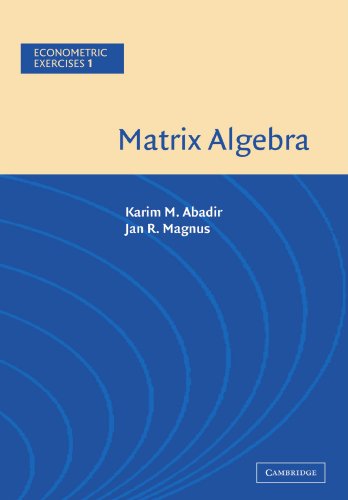
The first volume of the Econometric Exercises Series, Matrix Algebra contains exercises relating to course material in matrix algebra that students are expected to know while enrolled in an (advanced) undegraduate or a postgraduate course in econometrics or statistics. The book features a comprehensive collection of exercises with complete answers. More than just a collection of exercises, the volume is a textbook organized in a completely different manner than the usual textbook. It can be used as a self-contained course in matrix algebra or as a supplementary text.

  • Sales Rank: #1467081 in Books
  • Brand: Brand: Cambridge University Press
  • Published on: 2005-08-22
  • Original language: English
  • Number of items: 1
  • Dimensions: 8.98" h x .94" w x 5.98" l, 1.68 pounds
  • Binding: Paperback
  • 466 pages
Features
  • Used Book in Good Condition

Review
"This collection of exercises in matrix algebra is useful as a text or a reference. It is clearly written and very thorough in its coverage of results used in econometrics. Besides basic topics, it has an excellent treatment of matrix inequalities, vectorization, and matrix calculus. It belongs on every econometrician's bookshelf." -Peter Schmidt, Michigan State University

About the Author
Karim Abadir has held a joint Chair since 1996 in the Department of Mathematics and Economics at the University of York, where he has been the founder and director of various degree programs. He has also taught at the American University in Cairo, the University of Oxford, and the University of Exeter. He became an Extramural Fellow at CentER (Tilburg University) in 1993. Professor Abadir is a holder of two Econometric Theory awards, and has authored many articles in top journals, including the Annals of Statistics, Econometric Theory, Econometrica, and the Journal of Physics. He is Coordinating Editor (and one of the founding editors) of the Econometrics Journal, and Associate Editor of Econometric Reviews, Econometric Theory, Journal of Financial Econometrics, and Portuguese Economic Journal. He is a Fellow of the Royal Statistical Society.

Jan Magnus is Professor of Econometrics, CentER and Department of Econometrics and Operations Research, Tilburg University, The Netherlands. He has also taught at the University of Amsterdam, The University of British Columbia, The London School of Economics, The University of Montreal, and The European University Institute among other places. His books include Matrix Differential Calculus (with H. Neudecker), Linear Structures, Methodology and Tacit Knowledge (with M. S. Morgan), and Econometrics: A First Course (in Russian with P. K. Katyshev and A. A. Peresetsky). Professor Magnus has written numerous articles in the leading journals, including Econometrica, The Annals of Statistics, The Journal of the American Statistical Association, Journal of Econometrics, Linear Algebra and Its Applications, and The Review of Income and Wealth. He is a Fellow of the Journal of Econometrics, holder of the Econometric Theory Award, and associate editor of The Journal of Economic Methodology, Computational Statistics and Data Analysis, and the Journal of Multivariate Analysis.

Most helpful customer reviews

0 of 0 people found the following review helpful.
fantastic reference book for engineering researchers
By Shag84
I have found this book invaluable in my dissertation in communications theory, which has some detailed linear algebra work. While Horn and Johnson's book is considered the linear algebra bible, many of the results in that book are more geared towards mathematicians. This book, on the other hand, has many results that are excellent for engineering. The book is laid out in a straightforward fashion, and I have found it easy to navigate the results. This book is a spectacular addition to the library of anyone working with applied linear algebra.

12 of 12 people found the following review helpful.
An excellent summary of many weird matrix results
By Stanislav Kolenikov
I have used this book as the source of inspiration for the introductory/background part of my doctorate level multivariate class when I was covering the foundations of matrix theory, this way and out. MANOVA and discriminant analysis are about the spectrum of W^{-1} B -- here are exercises on inverses, spectral decomposition, and traces. Marginal and conditional distributions of a multivariate normal are themselves normal -- here are block matrix results for inverses and such that those normality theorems are based on. Effects of non-normality come from the higher order moments -- here are Kronecker products to define those moments, and duplication matrices to deal with redundant elements. You want to see the effects of non-normality on your PCA or SEM procedures -- here are the matrix calculus results, the foundations of the matrix version of the delta method.

I won't be repeating the coverage of the book -- you can look at the Contents. What follows the Contents in the book is the list of exercises -- if you remember what it is that you want to find by name (Schur's inequality... 3x3 block inverse... determinant of the bordered Gramian...) you might be able to do that from that list. So the second use of the book beside the obvious source of homework, practice and test problems is a reference on the interesting results in matrix theory -- and not just the plain vanilla matrix algebra as one probably had had in their undergraduate courses (linear spaces, bases, ranks, linear systems, determinants, inverses -- and there's relatively not that much of it, as other books will have that covered in greater detail), but with all the stuff that one would need for serious multivariate research -- matrix calculus, vectorizations and Kronecker products, factorizations, commutation and duplication matrices. It was a savior for my research work time with those advanced results a couple of times.

Highly recommended for:
* any teacher of a graduate level course that involves serious matrix operations (advanced linear models, advanced multivariate statistics; the authors come from econometric tradition, so there must be some advanced econometric classes where that would be an important book, although I would probably see this stuff scattered over several courses, as far as I understand the typical econometric sequences);
* any researcher developing multivariate techniques that are heavily matrix-based. I work in structural equation modeling, and I've also found uses of matrix calculus in my earlier work in spatial statistics, although mostly based on earlier Jan Magnus' book with Heinz Neudecker, Matrix Calculus, that I was translating to Russian at some point in my life. Another suggested book specifically for multivariate results in matrix forms, in the most abstract ways, is Kollo and von Rosen, Advanced Multivariate Statistics with Matrices.

1 of 13 people found the following review helpful.
a good book
By Qu Feng
I think this book is a good reference book for the matrix tools used in econometrics.

See all 3 customer reviews...

Matrix Algebra (Econometric Exercises, Vol. 1), by Karim M. Abadir, Jan R. Magnus PDF
Matrix Algebra (Econometric Exercises, Vol. 1), by Karim M. Abadir, Jan R. Magnus EPub
Matrix Algebra (Econometric Exercises, Vol. 1), by Karim M. Abadir, Jan R. Magnus Doc
Matrix Algebra (Econometric Exercises, Vol. 1), by Karim M. Abadir, Jan R. Magnus iBooks
Matrix Algebra (Econometric Exercises, Vol. 1), by Karim M. Abadir, Jan R. Magnus rtf
Matrix Algebra (Econometric Exercises, Vol. 1), by Karim M. Abadir, Jan R. Magnus Mobipocket
Matrix Algebra (Econometric Exercises, Vol. 1), by Karim M. Abadir, Jan R. Magnus Kindle

Matrix Algebra (Econometric Exercises, Vol. 1), by Karim M. Abadir, Jan R. Magnus PDF

Matrix Algebra (Econometric Exercises, Vol. 1), by Karim M. Abadir, Jan R. Magnus PDF

Matrix Algebra (Econometric Exercises, Vol. 1), by Karim M. Abadir, Jan R. Magnus PDF

Selasa, 28 Oktober 2014

[G701.Ebook] Download Ebook Pitch Perfect: How to Say It Right the First Time, Every Time, by Bill McGowan

Download Ebook Pitch Perfect: How to Say It Right the First Time, Every Time, by Bill McGowan

The factor of why you could obtain as well as get this Pitch Perfect: How To Say It Right The First Time, Every Time, By Bill McGowan quicker is that this is guide in soft file kind. You could read the books Pitch Perfect: How To Say It Right The First Time, Every Time, By Bill McGowan any place you really want also you remain in the bus, workplace, home, and also other areas. Yet, you might not should relocate or bring the book Pitch Perfect: How To Say It Right The First Time, Every Time, By Bill McGowan print wherever you go. So, you won't have much heavier bag to carry. This is why your selection to make better concept of reading Pitch Perfect: How To Say It Right The First Time, Every Time, By Bill McGowan is truly handy from this instance.

Pitch Perfect: How to Say It Right the First Time, Every Time, by Bill McGowan

Pitch Perfect: How to Say It Right the First Time, Every Time, by Bill McGowan


Pitch Perfect: How to Say It Right the First Time, Every Time, by Bill McGowan

Download Ebook Pitch Perfect: How to Say It Right the First Time, Every Time, by Bill McGowan

Pitch Perfect: How To Say It Right The First Time, Every Time, By Bill McGowan. Adjustment your behavior to hang or squander the time to just talk with your good friends. It is done by your everyday, don't you feel tired? Currently, we will reveal you the new routine that, really it's a very old practice to do that can make your life much more qualified. When feeling tired of constantly talking with your friends all free time, you could locate guide qualify Pitch Perfect: How To Say It Right The First Time, Every Time, By Bill McGowan then read it.

Also the rate of a publication Pitch Perfect: How To Say It Right The First Time, Every Time, By Bill McGowan is so inexpensive; many people are really stingy to establish aside their money to get guides. The various other reasons are that they feel bad as well as have no time at all to visit the publication establishment to search the publication Pitch Perfect: How To Say It Right The First Time, Every Time, By Bill McGowan to review. Well, this is modern period; many publications could be got easily. As this Pitch Perfect: How To Say It Right The First Time, Every Time, By Bill McGowan and also much more publications, they can be entered very quick methods. You will certainly not require to go outside to get this publication Pitch Perfect: How To Say It Right The First Time, Every Time, By Bill McGowan

By visiting this page, you have done the best gazing point. This is your begin to select guide Pitch Perfect: How To Say It Right The First Time, Every Time, By Bill McGowan that you really want. There are whole lots of referred e-books to check out. When you wish to get this Pitch Perfect: How To Say It Right The First Time, Every Time, By Bill McGowan as your book reading, you can click the web link page to download and install Pitch Perfect: How To Say It Right The First Time, Every Time, By Bill McGowan In few time, you have actually possessed your referred publications as your own.

As a result of this publication Pitch Perfect: How To Say It Right The First Time, Every Time, By Bill McGowan is marketed by on the internet, it will reduce you not to publish it. you could get the soft documents of this Pitch Perfect: How To Say It Right The First Time, Every Time, By Bill McGowan to conserve in your computer, device, and also much more devices. It depends on your readiness where as well as where you will certainly check out Pitch Perfect: How To Say It Right The First Time, Every Time, By Bill McGowan One that you have to constantly keep in mind is that reviewing book Pitch Perfect: How To Say It Right The First Time, Every Time, By Bill McGowan will never ever end. You will certainly have going to read various other publication after completing a publication, as well as it's constantly.

Pitch Perfect: How to Say It Right the First Time, Every Time, by Bill McGowan

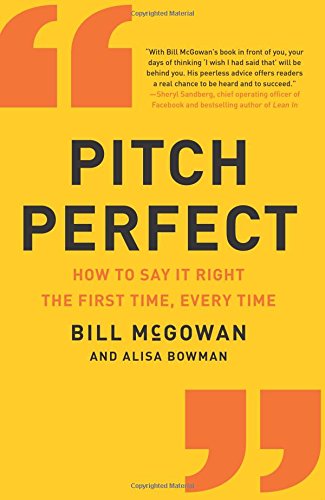
During the pivotal moments of our lives, results are often determined not only by our actions but also by our words. Saying the right thing the right way can make the difference between sealing the deal or losing the account, advancing your career or suffering a demotion.

In these moments, it’s important to be pitch perfect—to use precisely the right tone to convey the right message to the right person at the right time. In Pitch Perfect, the renowned media coach Bill McGowan shows you how to craft just the right message. Along the way, McGowan lays out his Seven Principles of Persuasion, which are as easy to learn, implement, and master as they are effective. The right language—both verbal and nonverbal—can make you more confident, persuasive, and certain. It can stir people to listen closely to your every word and to remember you long after you’ve left the room.

  • Sales Rank: #16002 in Books
  • Published on: 2016-09-13
  • Released on: 2016-09-13
  • Original language: English
  • Number of items: 1
  • Dimensions: 8.00" h x .65" w x 5.31" l, .0 pounds
  • Binding: Paperback
  • 288 pages

From Booklist
McGowan is a veteran in the television business as reporter, writer, producer, and anchor for shows such as ABC News 20/20; CBS News 48 Hours, and Public Eye with Bryant Gumbel. In 2004, he founded Clarity Media Group, a communications coaching firm dedicated to enhancing the speaking skills of corporate executives, celebrities, and athletes. He has coached Jack Welch, Mary J. Blige, Eli Manning, Connie Chung, and more than 60 executives at Facebook, including Mark Zuckerberg. His training helps public speakers and interviewees overcome fear and avoid bad speaking habits, grab people’s attention, keep them engaged, and deliver a powerful message. He has distilled his training techniques down to seven principles that can be employed by anyone to get their communication skills into shape. Some of these include The Headline Principle (starting with your best material), The Pasta-Sauce Principle (boiling down your message), The Self-Conviction Principle, and The Curiosity Principle (displaying genuine interest in your subject). McGowan promises to reveal everything he knows about communication, including his most important advice, of putting his principles into practice in everyday situations. --David Siegfried

Review
With Bill McGowan’s book in front of you, your days of thinking “I wish I had said that” will be behind you. His peerless advice offers readers a real chance to be heard and to succeed. (Sheryl Sandberg)

“Bill McGowan has captured the indefinable human essence of his teaching on the written page. You are assured of learning more than you can imagine while enjoying Pitch Perfect.” (Wynton Marsalis, managing and artistic director, Jazz at Lincoln Center)

“[This] guidebook....is evenhanded and straightforward and brims with advice for anyone hoping to brush up on public speaking, effective presentation skills and interviewing prowess both within and outside of the contemporary workforce marketplace.” (Kirkus Reviews)

“Success depends on having a great game plan. In Pitch Perfect, Bill McGowan provides just that-winning strategies for how to improve your communication skills, especially in life’s red-zone situations.” (Eli Manning, quarterback, New York Giants)

“In today’s world of micromessages and fleeting attention spans, connecting with your audience is more important than ever. Bill McGowan’s Pitch Perfect provides valuable and proven strategies for anyone looking to communicate effectively.” (Denise Morrison, president and CEO, Campbell Soup Company)

“Bill McGowan has identified a fresh and simple way for us to rethink how we communicate. His innovative strategies work not just in our professional lives but in everyday life as well. That’s why he’s an excellent teacher and why I always enjoy working with him.” (Daniel Ek, CEO, Spotify)

“Bill McGowan proves in Pitch Perfect what his clients already know-he is the premiere communications coach in business today. His insightful advice and strategies work.” (Thomas Keller, The French Laundry)

“You can learn to express yourself more effectively, handle difficult conversations gracefully and deliver a great presentation by following and practicing…McGowan packs the book with valuable examples of what was said versus what should have been said…Filled with smart, valuable advice, Pitch Perfect is a home run.” (Success)

From the Back Cover

The media coach and Emmy Award-winning correspondent Bill McGowan shares his secrets of pitch-perfect communications, showing readers how to communicate with confidence.

During the pivotal moments of our lives, results are often determined not only by our actions but by our words as well. Saying the right thing the right way can make the difference between sealing the deal or losing the account, advancing your career or suffering a demotion. During these moments, it's important to be pitch perfect—to use precisely the right tone to convey the right message to the right person at the right time. Such pitch-perfect moments are crucial in our personal and professional journeys. In Pitch Perfect, the renowned media coach Bill McGowan shows you how to craft just the right message. Along the way, McGowan lays out his Seven Principles of Persuasion, including:

  • The Scorsese Principle: Hold your audience's attention with visual images. Direct the film that plays in your listener's mind.
  • The No-Tailgating Principle: Avoid verbal fender-benders and career-wrecking moments by maintaining a safe talking distance. When in doubt, stop talking and listen.
  • The Pasta-Sauce Principle: Cure boredom by boiling down your message, making it as rich and brief as possible.

In Pitch Perfect, you'll learn how to overcome all these communication pitfalls. The Seven Principles of Persuasion are as easy to learn, implement, and master as they are effective. The right language—both verbal and nonverbal—can make you more confident, persuasive, and certain. It can stir people to listen closely to your every word and to remember you long after you've left the room.

Most helpful customer reviews

3 of 3 people found the following review helpful.
Pitch Perfect is Perfectly on Point.
By Kindle Customer
Pitch Perfect is Perfectly on Point.

I am a culinary and a communications professional with a lot of interview experience. I bought Pitch Perfect because of the author’s experience and background as a producer and a reporter—and the excellent reviews on amazon. In the beginning of the book, he tells the story of how he made the switch from being on TV to coaching people to be more effective communicators (on TV and beyond). And, his first “client” was right. He is great at it! The book feels like an extended one-on-one session. It captures the feel of a meaty working session with all of the tips, techniques and strategies for successful and effective communication laid out in simple and easily digestible terms. Not surprising, my favorite “Pitch Perfect Principle” is The Pasta-Sauce Principle which underscores my favorite cooking adage of ‘less is more.’ McGowen states, “...good communication is a lot like pasta sauce. The more you boil down and reduce a sauce, the more dynamic the flavor.”
Never was a truer principle told, and by connecting it to pasta sauce, it is unforgettable. Buy the book. Read the book. Live the book. It will make all your communication better, not just interviews and presentations.

1 of 1 people found the following review helpful.
Great for anyone who needs to communicate orally
By Jonathan Groner
This book is great fun and full of excellent advice. As a fairly successful public speaker (when I have had to speak), I must say that McGowan has it right. A lot of the "old" advice from the 1970s, like envisioning your audience in underwear, is ineffective, he says, and makes no sense. McGowan's better advice: There's no substitute for preparation. I loved his recommended ways of steering an inappropriate or ineffective conversation into a better path without insulting the person who went in the wrong direction. His stories about celebrities or near-celebrities who didn't heed his advice are absolutely hilarious. As McGowan says, please don't invent words in your pitch like "thrival," and expect your audience to be thrilled! You will only sound strange.

3 of 3 people found the following review helpful.
Great advice, don't pass this one by!
By Elizabeth Hope
I love this book! Pitch perfect is a great guidebook for anyone who wants to make a good impression in any kind of social situation. The advice offered here can help you whether you're talking to one person or a whole audience.
As a visual artist, presenting has never been my fort�, in fact just the idea of being the focus of attention has always been nerve-racking for me. But I found the author's tone, wealth of experience and depth of knowledge so helpful and reassuring that I am actually looking forward to putting his ideas into play.
It's hard to imagine a situation where you wouldn't benefit from the savvy advice offered here. Whether you're presenting an idea, giving a talk, being interviewed or just interacting with others you can gain really useful tips and insights on what to do as well as what not to do, to always make the best impression. As McGowan reminds us "...there are no second takes in real life. That's why it's so important to say it right the first time, every time." How true!
If you're like me and not comfortable being the focus of attention it's wise to call in an expert. Reading this book is like having private practice sessions with a coach who knows the territory like the back of his hand. I appreciate how McGowan points out specific pitfalls to avoid ahead of time, this is where his experience really shines through. There is a good balance of common sense, insider information and humor that had me laughing out loud. You can learn a lot from other's mistakes illustrated throughout the book, McGowan even includes some of his own not so pitch perfect moments which kept his advice from seeming preachy. I felt encouraged throughout the book especially when he shares that "Pitch-Perfect communication is not just vital, it's also something anyone can learn." and he promises to impart everything he knows and has learned from his 30 years in television and 4,000 coaching sessions so the reader can "come away with a thorough yet simple set of principles for deftly handling a wide variety of personal and professional communications scenarios so you can achieve the best of all possible results." Wow, that's a big promise but in my opinion McGowan delivers. I can't wait to share this with my friends. I highly recommend getting the audio version too. I especially enjoyed listening to McGowan's great delivery and conversational style. It feels like he's right there with you! His level of experience and confidence spills out from every page, and I already feel greatly reassured that awkward presentations and unconscious self sabotage are now a thing of the past. Get your highlighters ready, this advice is too good to forget and worth every penny.

See all 168 customer reviews...

Pitch Perfect: How to Say It Right the First Time, Every Time, by Bill McGowan PDF
Pitch Perfect: How to Say It Right the First Time, Every Time, by Bill McGowan EPub
Pitch Perfect: How to Say It Right the First Time, Every Time, by Bill McGowan Doc
Pitch Perfect: How to Say It Right the First Time, Every Time, by Bill McGowan iBooks
Pitch Perfect: How to Say It Right the First Time, Every Time, by Bill McGowan rtf
Pitch Perfect: How to Say It Right the First Time, Every Time, by Bill McGowan Mobipocket
Pitch Perfect: How to Say It Right the First Time, Every Time, by Bill McGowan Kindle

Pitch Perfect: How to Say It Right the First Time, Every Time, by Bill McGowan PDF

Pitch Perfect: How to Say It Right the First Time, Every Time, by Bill McGowan PDF

Pitch Perfect: How to Say It Right the First Time, Every Time, by Bill McGowan PDF

Jumat, 24 Oktober 2014

[K606.Ebook] Ebook Aquinas's Disputed Questions on Evil: A Critical Guide (Cambridge Critical Guides)From Cambridge University Press

Ebook Aquinas's Disputed Questions on Evil: A Critical Guide (Cambridge Critical Guides)From Cambridge University Press

For this reason, this internet site offers for you to cover your issue. We reveal you some referred books Aquinas's Disputed Questions On Evil: A Critical Guide (Cambridge Critical Guides)From Cambridge University Press in all types as well as themes. From typical writer to the popular one, they are all covered to give in this website. This Aquinas's Disputed Questions On Evil: A Critical Guide (Cambridge Critical Guides)From Cambridge University Press is you're searched for publication; you simply need to visit the web link page to show in this web site then choose downloading. It will not take many times to get one book Aquinas's Disputed Questions On Evil: A Critical Guide (Cambridge Critical Guides)From Cambridge University Press It will certainly depend on your net link. Merely acquisition and also download and install the soft documents of this publication Aquinas's Disputed Questions On Evil: A Critical Guide (Cambridge Critical Guides)From Cambridge University Press

Aquinas's Disputed Questions on Evil: A Critical Guide (Cambridge Critical Guides)From Cambridge University Press

Aquinas's Disputed Questions on Evil: A Critical Guide (Cambridge Critical Guides)From Cambridge University Press


Aquinas's Disputed Questions on Evil: A Critical Guide (Cambridge Critical Guides)From Cambridge University Press

Ebook Aquinas's Disputed Questions on Evil: A Critical Guide (Cambridge Critical Guides)From Cambridge University Press

Aquinas's Disputed Questions On Evil: A Critical Guide (Cambridge Critical Guides)From Cambridge University Press. It is the time to improve and also revitalize your skill, expertise and experience included some enjoyment for you after very long time with monotone points. Working in the workplace, visiting research, learning from examination as well as more activities might be completed and also you need to start new points. If you feel so exhausted, why don't you try brand-new point? A quite simple thing? Reading Aquinas's Disputed Questions On Evil: A Critical Guide (Cambridge Critical Guides)From Cambridge University Press is exactly what we offer to you will certainly know. And the book with the title Aquinas's Disputed Questions On Evil: A Critical Guide (Cambridge Critical Guides)From Cambridge University Press is the reference currently.

Reading book Aquinas's Disputed Questions On Evil: A Critical Guide (Cambridge Critical Guides)From Cambridge University Press, nowadays, will not require you to consistently buy in the store off-line. There is a terrific place to acquire guide Aquinas's Disputed Questions On Evil: A Critical Guide (Cambridge Critical Guides)From Cambridge University Press by online. This site is the very best site with great deals numbers of book collections. As this Aquinas's Disputed Questions On Evil: A Critical Guide (Cambridge Critical Guides)From Cambridge University Press will be in this book, all publications that you require will be right here, also. Merely hunt for the name or title of the book Aquinas's Disputed Questions On Evil: A Critical Guide (Cambridge Critical Guides)From Cambridge University Press You could locate what exactly you are hunting for.

So, even you require responsibility from the company, you might not be confused any more since publications Aquinas's Disputed Questions On Evil: A Critical Guide (Cambridge Critical Guides)From Cambridge University Press will certainly always help you. If this Aquinas's Disputed Questions On Evil: A Critical Guide (Cambridge Critical Guides)From Cambridge University Press is your best companion today to cover your work or job, you could as soon as possible get this book. How? As we have informed recently, merely visit the web link that our company offer below. The verdict is not only guide Aquinas's Disputed Questions On Evil: A Critical Guide (Cambridge Critical Guides)From Cambridge University Press that you search for; it is just how you will certainly get lots of books to support your ability and also capability to have great performance.

We will reveal you the most effective and most convenient means to get book Aquinas's Disputed Questions On Evil: A Critical Guide (Cambridge Critical Guides)From Cambridge University Press in this world. Bunches of compilations that will certainly assist your task will be right here. It will certainly make you really feel so ideal to be part of this site. Becoming the member to always see just what up-to-date from this publication Aquinas's Disputed Questions On Evil: A Critical Guide (Cambridge Critical Guides)From Cambridge University Press site will certainly make you really feel ideal to look for guides. So, just now, as well as here, get this Aquinas's Disputed Questions On Evil: A Critical Guide (Cambridge Critical Guides)From Cambridge University Press to download and install as well as save it for your valuable worthwhile.

Aquinas's Disputed Questions on Evil: A Critical Guide (Cambridge Critical Guides)From Cambridge University Press

Thomas Aquinas's Disputed Questions on Evil is a careful and detailed analysis of the general topic of evil, including discussions on evil as privation, human free choice, the cause of moral evil, moral failure, and the so-called seven deadly sins. This collection of ten, specially commissioned new essays, the first book-length English-language study of Disputed Questions on Evil, examines the most interesting and philosophically relevant aspects of Aquinas's work, highlighting what is distinctive about it and situating it in relation not only to Aquinas's other works but also to contemporary philosophical debates in metaphysics, ethics, and philosophy of action. The essays also explore the history of the work's interpretation. The volume will be of interest to researchers in a broad range of philosophical disciplines including medieval philosophy and history of philosophy, as well as to theologians.

  • Sales Rank: #2063443 in Books
  • Published on: 2015-11-26
  • Original language: English
  • Number of items: 1
  • Dimensions: 8.98" h x .63" w x 5.98" l, .0 pounds
  • Binding: Hardcover
  • 264 pages

Review
"This volume contains insightful and well-argued essays ... illuminating the nature and application of the claims that Thomas makes in De malo. Readers of Thomas will be grateful for its appearance."
Robert C. Miner, Baylor University

About the Author
M. V. Dougherty is Professor of Philosophy at Ohio Dominican University. He is the author of Moral Dilemmas in Medieval Thought: From Gratian to Aquinas (Cambridge, 2011) and editor of Pico della Mirandola: New Essays (Cambridge, 2008).

Most helpful customer reviews

See all customer reviews...

Aquinas's Disputed Questions on Evil: A Critical Guide (Cambridge Critical Guides)From Cambridge University Press PDF
Aquinas's Disputed Questions on Evil: A Critical Guide (Cambridge Critical Guides)From Cambridge University Press EPub
Aquinas's Disputed Questions on Evil: A Critical Guide (Cambridge Critical Guides)From Cambridge University Press Doc
Aquinas's Disputed Questions on Evil: A Critical Guide (Cambridge Critical Guides)From Cambridge University Press iBooks
Aquinas's Disputed Questions on Evil: A Critical Guide (Cambridge Critical Guides)From Cambridge University Press rtf
Aquinas's Disputed Questions on Evil: A Critical Guide (Cambridge Critical Guides)From Cambridge University Press Mobipocket
Aquinas's Disputed Questions on Evil: A Critical Guide (Cambridge Critical Guides)From Cambridge University Press Kindle

Aquinas's Disputed Questions on Evil: A Critical Guide (Cambridge Critical Guides)From Cambridge University Press PDF

Aquinas's Disputed Questions on Evil: A Critical Guide (Cambridge Critical Guides)From Cambridge University Press PDF

Aquinas's Disputed Questions on Evil: A Critical Guide (Cambridge Critical Guides)From Cambridge University Press PDF